When Medical Information Moves Beyond the Page
Medical Pharmaceutical Translations • Oct 26, 2026, 12:00:05 PM
For decades, much of the information exchanged across the life sciences industry has been document-based. Clinical protocols, regulatory submissions, product labeling, patient information leaflets, and scientific publications have traditionally formed the foundation of global healthcare communication. Those documents remain essential. But they no longer represent the full picture.
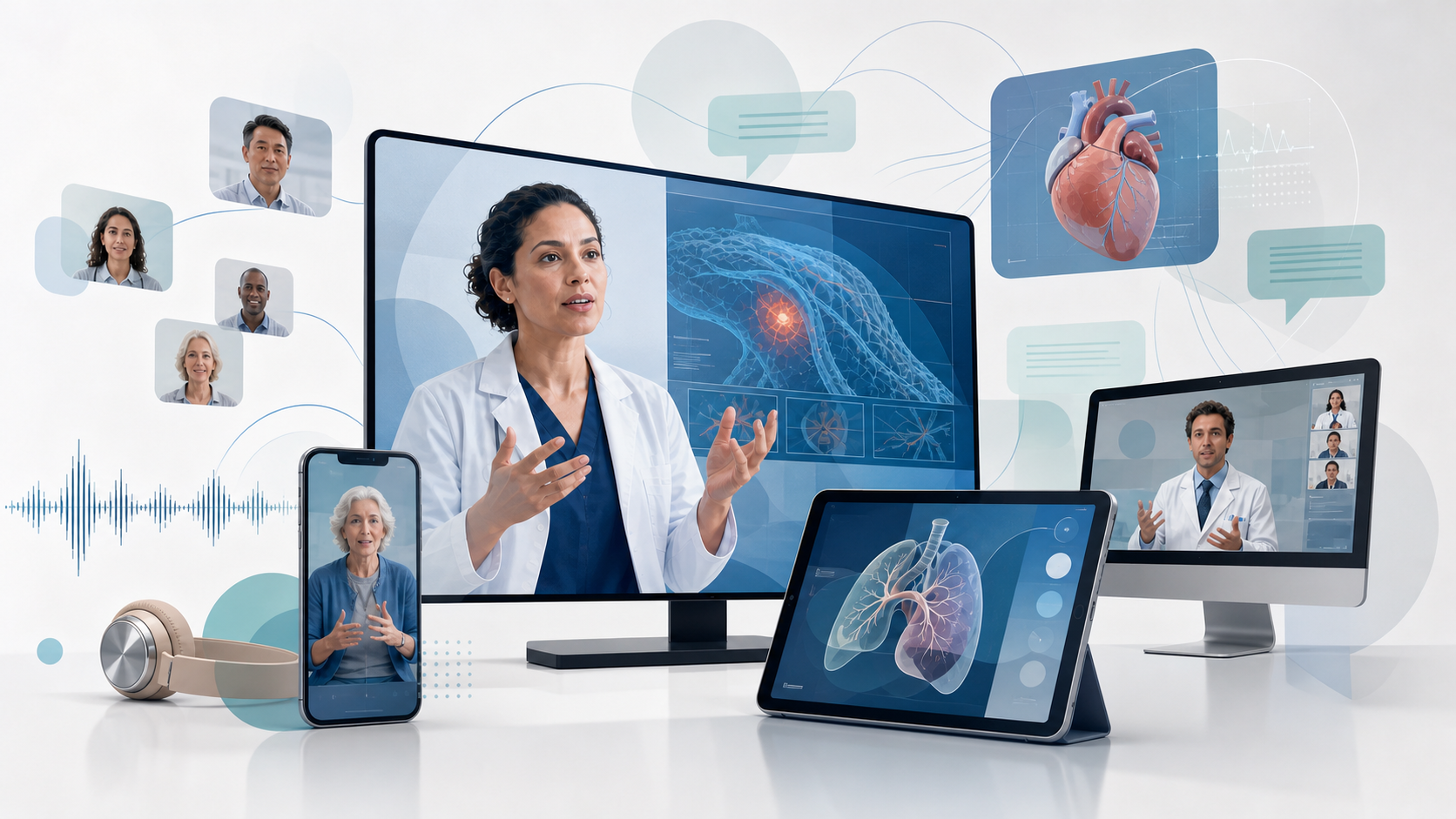
Today, healthcare information is increasingly communicated through videos, webinars, podcasts, interactive training modules, medical animations, and digital patient-support platforms. A pharmaceutical company may use video to explain a treatment, a medical device manufacturer may demonstrate how to operate equipment, and a clinical research organization may deliver investigator training through an online learning platform.
These formats offer new opportunities to make complex information more engaging and easier to understand. They also introduce challenges that traditional document-based translation workflows were not necessarily designed to address.
As healthcare communication moves beyond the written word, multilingual strategies need to evolve with it.
The Growing Role of Audiovisual Content in Life Sciences
Audiovisual content is becoming an important part of how healthcare organizations communicate with different audiences.
For patients, instructional videos can demonstrate how to administer medication, use a medical device, or prepare for a medical procedure. Healthcare professionals may rely on recorded training sessions, scientific presentations, and educational webinars to stay informed about new developments. Within pharmaceutical and medical device companies, audiovisual materials also support employee training, product launches, clinical research, and communication between international teams.
Unlike traditional written documents, these formats combine several elements to convey information. Spoken language, visual demonstrations, on-screen instructions, graphics, timing, and tone all contribute to the message. When that content needs to reach audiences in different languages, translating the script is only one part of the process.
When Words, Images, and Timing Must Work Together
Consider a video demonstrating how to use a medical device. The narrator explains each step while an animation highlights specific buttons, displays, or components. Instructions appear on screen at carefully selected moments, synchronized with the visual demonstration. Now imagine localizing that video for several international markets.
The translated narration may be longer than the original. Technical terminology may require more words in one language than another. On-screen labels may need to be replaced, and subtitles must remain synchronized with the actions being demonstrated.
A translation can be technically accurate but still create confusion if the spoken instruction no longer matches what the viewer sees. For medical content, these inconsistencies can have consequences beyond an awkward viewing experience.
If an instruction appears too early, too late, or in a way that conflicts with the visual demonstration, viewers may misunderstand an important step. Effective audiovisual localization therefore requires coordination between linguistic specialists, medical reviewers, video editors, and multimedia production teams.
The goal is not simply to translate every spoken sentence. It is to preserve the relationship between language and the visual information that gives it meaning.
Scientific Accuracy Across Different Formats
Life sciences content presents additional complexity because it often includes specialized terminology, precise instructions, and information subject to regulatory or scientific review.
A medical webinar may include technical discussions, abbreviations, drug names, and references to clinical evidence. A patient education video may need to communicate similar information using more accessible language. These differences influence how content should be localized.
Subtitling, for example, requires balancing accuracy with reading speed and available screen space. Voice-over must account for timing, pronunciation, and the relationship between narration and visuals. Dubbing introduces further constraints because translated dialogue must fit the duration and rhythm of the original presentation.
The challenge is especially significant when information cannot be simplified without changing its meaning. Medical terminology, dosage instructions, contraindications, and safety-related statements require careful handling, regardless of the format in which they appear. This makes audiovisual localization a multidisciplinary process rather than a straightforward extension of document translation.
The Hidden Complexity of Updating Multimedia Content
Another challenge emerges after the original content has been published.
Healthcare information changes. Product instructions are revised, new safety information becomes available, and scientific recommendations evolve. Updating a written document may involve replacing specific passages and completing the necessary review and approval procedures. Updating a multilingual video can be considerably more complicated.
A change to a single instruction may require revising the source script, updating translations, recording new narration, modifying subtitles, replacing on-screen graphics, and reviewing the final video in every affected language.
If several versions are distributed across different websites, learning platforms, or regional channels, organizations also need to ensure that outdated materials are identified and replaced. This creates an important operational question: how can healthcare organizations maintain consistency when the same information exists across multiple formats, languages, and platforms?
The answer increasingly depends on planning for localization and future updates during content development rather than treating multilingual adaptation as a final production step.
Where AI Fits Into Audiovisual Localization
Artificial intelligence is introducing new possibilities for multimedia localization. Automated transcription, AI-generated subtitles, synthetic voices, and AI-assisted dubbing can help organizations process audiovisual content faster. These technologies may be particularly useful when managing large volumes of training materials, recorded presentations, or frequently updated digital content.
However, their use in life sciences requires careful consideration. Automated transcription can misinterpret specialized terminology, drug names, or numerical information. AI-generated subtitles may omit details or introduce errors. Synthetic narration can reproduce words accurately while placing emphasis in ways that affect how an instruction is understood.
These risks do not mean AI has no place in audiovisual localization. They mean that the level of human review and quality assurance should reflect the intended audience, content type, and potential consequences of an error. A general educational webinar and a video explaining how to administer a medication may require very different validation and review processes.
As audiovisual localization becomes more automated, organizations will need to define where technology adds efficiency and where specialized human expertise remains essential.
Planning for a Multilingual Multimedia Future
The expansion of audiovisual content presents an opportunity for life sciences organizations to rethink how they develop and manage global communication. Rather than creating content in one language and adapting it later, organizations can design multimedia materials with international audiences in mind from the beginning.
This may involve preparing scripts that allow for language expansion, separating on-screen text from visual elements, maintaining editable source files, and ensuring that terminology resources are available to everyone involved in localization. It also means considering how audiovisual materials will be maintained throughout their lifecycle.
World Day for Audiovisual Heritage, observed on October 27, offers a useful reminder that audiovisual materials are valuable records of knowledge and communication. In healthcare, their value also depends on remaining accurate, understandable, and usable as scientific information evolves. As videos, audio, and interactive media become increasingly integrated into healthcare communication, multilingual content management can no longer focus exclusively on documents.
The future of global healthcare communication will depend not only on what organizations say, but on how effectively they preserve meaning across every format in which that information is delivered.